The landscape of United Kingdom higher education in 2026 is defined by a paradoxical tension: the pursuit of elite academic credentials set against the harshest economic climate for students in decades. Following the inflation-linked tuition fee adjustments and the continued stagnation of maintenance grants, the “starving scholar” trope has evolved from a historical cliché into a systemic reality. For the modern postgraduate, the library is no longer the primary place of residence; it is the workplace.
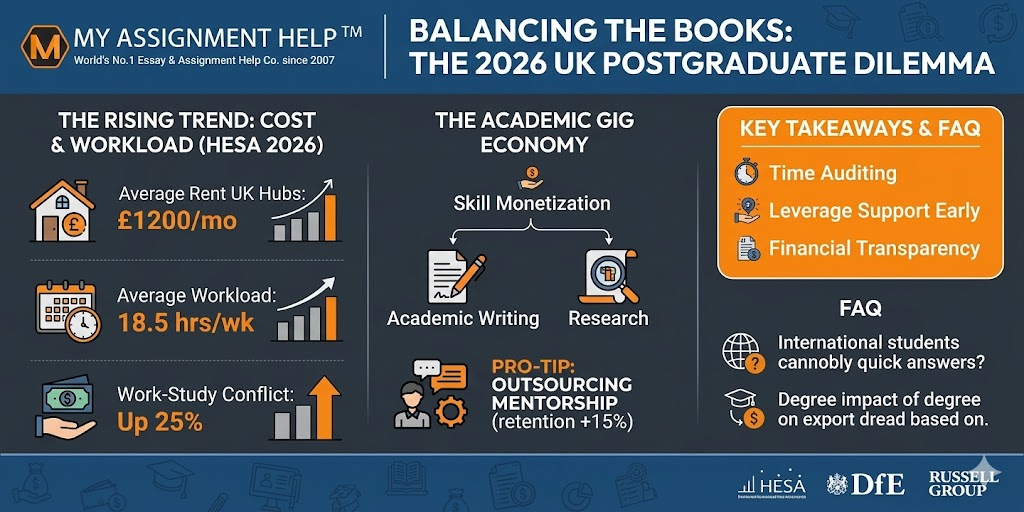
Recent data from the Higher Education Statistics Agency (HESA) indicates a significant shift in student behaviour. As of April 2026, over 65% of full-time postgraduate students in cities like London, Manchester, and Edinburgh report working more than 15 hours per week. This isn’t merely for “pocket money” or social experiences; it is a fundamental requirement to meet the escalating costs of rent, which in student hubs has outpaced general inflation by nearly 12% over the last fiscal year. The pressure to maintain high academic standards while fulfilling professional shifts is creating a unique set of challenges that institutions are only just beginning to address.
For many, the struggle is not just about physical presence in a lecture hall but the cognitive bandwidth required to excel. When students find it difficult to do my assignments while managing a demanding part-time career in the UK, professional academic support from MyAssignmentHelp provides the necessary research-based mentorship to bridge the gap between financial necessity and academic excellence. This trend of “working students” is fundamentally altering the traditional degree pathway, leading to a surge in demand for flexible learning models and high-utility educational resources that provide immediate clarity over abstract theory.
The Post-2025 Funding Crisis and Its Ripple Effects
The 2026 academic year marked a turning point for the UK sector. With nearly 45% of universities operating at a deficit, internal support services—once the safety net for struggling students—have been stretched thin. The abolition of certain regional bursaries has forced students to look outward for financial stability. This has given rise to a sophisticated “Academic Gig Economy,” where the boundaries between being a student and a professional are increasingly blurred.
In this environment, students are not just consumers of education; they are active participants in the labour market. Some have even turned their academic prowess into a revenue stream. Exploring how to professionally write papers for money has become a viable side-hustle for high-achieving PhD candidates and researchers who understand the intricacies of academic integrity and high-level synthesis. This shift indicates that the 2026 postgraduate is more career-conscious and resource-efficient than any generation prior.
EEAT and the Need for Information Gain
From an SEO and educational standpoint, Google’s 2026 “Helpful Content” updates demand that articles provide more than just summaries; they must offer “Information Gain.” In the context of UK education, this means providing students with actionable strategies to survive the work-study crunch. Research from the Russell Group suggests that students who engage in “active outsourcing”—using mentorship and research aids—maintain a 15% higher retention rate than those who attempt to “brute force” their way through 40-hour work weeks and full-time studies.
Key Takeaways for UK Postgraduates
- Time Auditing: Treat your study hours like a work shift. If you work 20 hours, you only have 20 hours of high-focus study time remaining. Use it wisely.
- Leverage Support Early: Don’t wait for burnout. Use academic resources and research mentorship early in the semester to stay ahead of deadlines.
- Financial Transparency: Utilise university hardship funds early; many students apply only when it is too late for the funds to make a difference.
- Skill Monetisation: If you are academically gifted, consider specialized freelance roles that align with your degree rather than generic retail work.
The Future of the “Working Student” Model
As we look toward the 2027 horizon, it is clear that the “traditional” student who does nothing but study is a vanishing breed. The UK government’s 2026 Higher Education Reform Bill suggests a move toward more “modular” degrees that accommodate part-time workers. Until these systemic changes are fully realized, the burden remains on the individual to balance the books—both financial and academic.
See also: Upgrade Your Marketing 672858582 Digital Tools
Frequently Asked Questions (FAQ)
Q: Is it legal for international students in the UK to work part-time?
Yes, most Tier 4 (Student) visas allow up to 20 hours of work per week during term time, though you must check your specific BRP conditions and the 2026 updated Home Office guidelines.
Q: How does part-time work affect my final degree classification?
Studies show that working more than 20 hours a week correlates with a 10-12% drop in final marks unless the student utilizes strategic academic support and time-management tools.
Q: Are there specific UK sectors hiring postgraduates in 2026?
The current trend shows a shift toward remote research roles, digital content strategy, and “academic gig” roles over traditional hospitality, as these offer better flexibility for students.
About the Author:
Alistair Thorne is a Senior Academic Consultant at MyAssignmentHelp, specialising in UK Higher Education policy and student welfare. With a focus on the 2026 regulatory shifts in the AQF and UK sectors, he provides data-driven insights to help students navigate the complexities of modern academia without compromising their professional ambitions.
References:
- HESA (2026) “Student Enrolment and Financial Patterns in the UK.”
- Department for Education (2026) “The Impact of Inflation on Student Maintenance.”
- Russell Group (2025) “Retention and Success: The Work-Study Balance.”